Nowruz BandB
Nowruz BandB
If you like to stay in Isfahan for a night or more, we suggest you Nowruz B&B.
You are very welcome to your home in Isfahan.
This house situated in the old center of Isfahan, within 10 minutes walk to Naghsh-e-Jahan square.
It is a private apartment with kitchen, guest room, and two rooms available for guests.
This wonderful guest house situated in the old center of Isfahan.
Accommodation
Nowruz B&B offers tourists and travelers a memorable accommodation during their stay in Isfahan.
Our location is very close to main tourist attractions in Isfahan.
We will be very happy to make your stay in a friendly environment during your stay in Isfahan.
Our Rooms
This house has 2 rooms, each room suitable for 2 or 3 persons. The bathrooms are shared between
every guest.
Prices
50 Euros per night
Breakfast: Included
WiFi: Available
Parking: Free
Laundry service: Available
For Room Availability:
Email: behzad257@hotmail.com
Phone number: +98 9131253181
About Isfahan (from Wikipedia )
Isfahan (Persian: اصفهان, translit. Esfahān [esfæˈhɒːn], historically also rendered in English as Ispahan, Sepahan, Esfahan or Hispahan, is the capital of Isfahan Province in Iran, located about 340 kilometres (211 miles) south of Tehran.
The Greater Isfahan Region had a population of 1,756,104 in the 2011 Census, the third most populous metropolitan area in Iran after Tehran and Mashhad. Borkhar County, Najafabad County, Khomeyni Shahr County, Shahin Shahr and Meymeh County, Mobarakeh County, Falavarjan County, Tiran and Karvan County, Lenjan County and Isfahan County all constitute the metropolitan city of Isfahan.
Isfahan is located on the main north–south and east–west routes crossing Iran, and was once one of the largest cities in the world. It flourished from 1050 to 1722, particularly in the 16th and 17th centuries under the Safavid dynasty, when it became the capital of Persia for the second time in its history. Even today, the city retains much of its past glory. It is famous for its Persian–Islamic architecture, with many beautiful boulevards, covered bridges, palaces, mosques, and minarets. This led to the Persian proverb "Esfahān nesf-e- jahān ast" (Isfahan is half of the world).
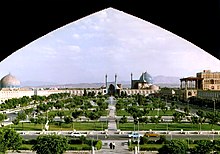
The Naghsh-e Jahan Square in Isfahan is one of the largest city squares in the world. It has been designated by UNESCO as a World Heritage Site. The city also has a wide variety of historic monuments and is known for the paintings, history and architecture.


.




The city core consists of an older section, revolving around the Jameh Mosque, and the Safavid expansion around Naqsh-e Jahan Square, with the surrounding worship places, palaces, and bazaars.
The bridges over the river include some of the finest architecture in Isfahan. The oldest bridge is the Shahrestan bridge, whose foundations was built by the Sasanian Empire (3rd-7th century Sassanid era) and has been repaired during the Seljuk period. Further upstream is Khaju bridge, which was built by Shah Abbas II in 1650. It is 123 metres (404 feet) long with 24 arches, and also serves as a sluice gate.
The next bridge is Choobi (Joui) bridge. It was originally built as an aqueduct to supply the palace gardens on the north bank of the river. Further upstream again is the Si-o-Seh Pol or bridge of 33 arches. Built during the rule of Shah Abbas the Great, it linked Isfahan with the Armenian suburb of New Julfa. It is by far the longest bridge in Isfahan at 295 m (967.85 ft).
Other bridges include Marnan Bridge.

If you like to stay in Isfahan for a night or more, we suggest you Nowruz B&B.
You are very welcome to your home in Isfahan.
This house situated in the old center of Isfahan, within 10 minutes walk to Naghsh-e-Jahan square.
It is a private apartment with kitchen, guest room, and two rooms available for guests.
This wonderful guest house situated in the old center of Isfahan.
Accommodation
Nowruz B&B offers tourists and travelers a memorable accommodation during their stay in Isfahan.
Our location is very close to main tourist attractions in Isfahan.
We will be very happy to make your stay in a friendly environment during your stay in Isfahan.
Our Rooms
This house has 2 rooms, each room suitable for 2 or 3 persons. The bathrooms are shared between
every guest.
Prices
50 Euros per night
Breakfast: Included
WiFi: Available
Parking: Free
Laundry service: Available
For Room Availability:
Email: behzad257@hotmail.com
Phone number: +98 9131253181
About Isfahan (from Wikipedia )
Isfahan (Persian: اصفهان, translit. Esfahān [esfæˈhɒːn], historically also rendered in English as Ispahan, Sepahan, Esfahan or Hispahan, is the capital of Isfahan Province in Iran, located about 340 kilometres (211 miles) south of Tehran.
The Greater Isfahan Region had a population of 1,756,104 in the 2011 Census, the third most populous metropolitan area in Iran after Tehran and Mashhad. Borkhar County, Najafabad County, Khomeyni Shahr County, Shahin Shahr and Meymeh County, Mobarakeh County, Falavarjan County, Tiran and Karvan County, Lenjan County and Isfahan County all constitute the metropolitan city of Isfahan.
Isfahan is located on the main north–south and east–west routes crossing Iran, and was once one of the largest cities in the world. It flourished from 1050 to 1722, particularly in the 16th and 17th centuries under the Safavid dynasty, when it became the capital of Persia for the second time in its history. Even today, the city retains much of its past glory. It is famous for its Persian–Islamic architecture, with many beautiful boulevards, covered bridges, palaces, mosques, and minarets. This led to the Persian proverb "Esfahān nesf-e- jahān ast" (Isfahan is half of the world).
The Naghsh-e Jahan Square in Isfahan is one of the largest city squares in the world. It has been designated by UNESCO as a World Heritage Site. The city also has a wide variety of historic monuments and is known for the paintings, history and architecture.
Main sights

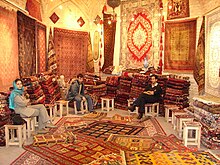
A handicraft shop

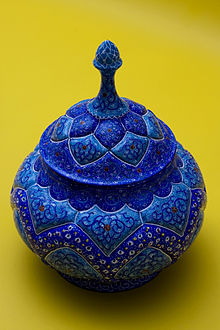
A handicraft from Isfahan

Shah Mosque. Painting by the French architect, Pascal Coste, visiting Persia in 1841


Naghsh-e-Jahan Square, Isfahan, Iran

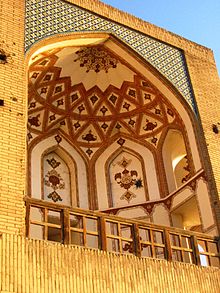
View of Ali Qapu Palace

A carpet shop in Grand Bazaar, Isfahan

Khaju Bridge

Detail of Khaju Bridge

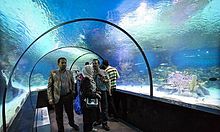
Isfahan aquarium

Bazaars
- Shahi Bazaar – 17th century
- Qeysarie Bazaar – 17th century
Bridges
The Zayande River starts in the Zagros Mountains, flows from west to east through the heart of Isfahan, and dries up in the Gavkhooni wetland.The bridges over the river include some of the finest architecture in Isfahan. The oldest bridge is the Shahrestan bridge, whose foundations was built by the Sasanian Empire (3rd-7th century Sassanid era) and has been repaired during the Seljuk period. Further upstream is Khaju bridge, which was built by Shah Abbas II in 1650. It is 123 metres (404 feet) long with 24 arches, and also serves as a sluice gate.
The next bridge is Choobi (Joui) bridge. It was originally built as an aqueduct to supply the palace gardens on the north bank of the river. Further upstream again is the Si-o-Seh Pol or bridge of 33 arches. Built during the rule of Shah Abbas the Great, it linked Isfahan with the Armenian suburb of New Julfa. It is by far the longest bridge in Isfahan at 295 m (967.85 ft).
Other bridges include Marnan Bridge.
Churches and cathedrals
- Bedkhem Church – 1627
- St. Georg Church – 17th century
- St. Jakob Church – 1607
- St. Mary Church – 17th century
- Vank Cathedral – 1664
Emamzadehs
- Emamzadeh Ahmad
- Emamzadeh Esmaeil, Isfahan
- Emamzadeh Haroun-e-Velayat – 16th century
- Emamzadeh Jafar
- Emamzadeh Shah Zeyd
Gardens and parks
Houses
- Alam's House
- Amin's House
- Malek Vineyard
- Qazvinis' House – 19th century
- Sheykh ol-Eslam's House
Mausoleums and tombs
- Al-Rashid Mausoleum – 12th century
- Baba Ghassem Mausoleum – 14th century
- Mausoleum of Safavid Princes
- Nizam al-Mulk Tomb – 11th century
- Saeb Mausoleum
- Shahshahan mausoleum – 15th century
- Soltan Bakht Agha Mausoleum – 14th century
Minarets
- Ali minaret – 11th century
- Bagh-e-Ghoushkhane minaret – 14th century
- Chehel Dokhtaran minaret – 12 century
- Dardasht minarets – 14th century
- Darozziafe minarets – 14th century
- Menar Jonban – 14th century
- Sarban minaret
Mosques
- Agha Nour mosque – 16th century
- Hakim Mosque
- Ilchi mosque
- Jameh Mosque[30]
- Jarchi mosque – 1610
- Lonban mosque
- Maghsoudbeyk mosque – 1601
- Mohammad Jafar Abadei mosque – 1878
- Rahim Khan mosque – 19th century
- Roknolmolk mosque
- Seyyed mosque – 19th century
- Shah Mosque – 1629
- Sheikh Lotf Allah Mosque – 1618
Museums
- Contemporary Arts Museum Isfahan
- Isfahan City Center Museum
- Museum of Decorative Arts
- Natural History Museum of Isfahan – 15th century
Schools (madresse)
- Chahar Bagh School – early 17th century
- Harati
- Kassegaran school – 1694
- Madreseye Khajoo
- Nimavar school – 1691
- Sadr school – 19th century
Palaces and caravanserais
- Ali Qapu (The Royal Palace) – early 17th century
- Chehel Sotoun (The Palace of Forty Columns) – 1647
- Hasht-Behesht (The Palace of Eight Paradises) – 1669
- Shah Caravanserai
- Talar Ashraf (The Palace of Ashraf) – 1650
Squares and streets

A view of Meydan Kohne
- Chaharbagh Boulevard – 1596
- Chaharbagh-e-khajou Boulevard
- Meydan Kohne (Old Square)
- Naqsh-e Jahan Square also known as "Shah Square" or "Imam Square" – 1602
Synagogues
- Kenisa-ye Bozorg (Mirakhor's kenisa)
- Kenisa-ye Molla Rabbi
- Kenisa-ye Sang-bast
- Mullah Jacob Synagogue
- Mullah Neissan Synagogue
- Kenisa-ye Keter David
Tourist attractions
The central historical area in Isfahan is called Seeosepol (the name of a famous bridge).Other sites
- Atashgah – a Zoroastrian fire temple
- The Bathhouse of Bahāʾ al-dīn al-ʿĀmilī
- Isfahan City Center
- Jarchi hammam
- New Julfa (The Armenian Quarter) – 1606
- Pigeon Towers[33] – 17th century
- Takht-e Foulad

Comments
Post a Comment